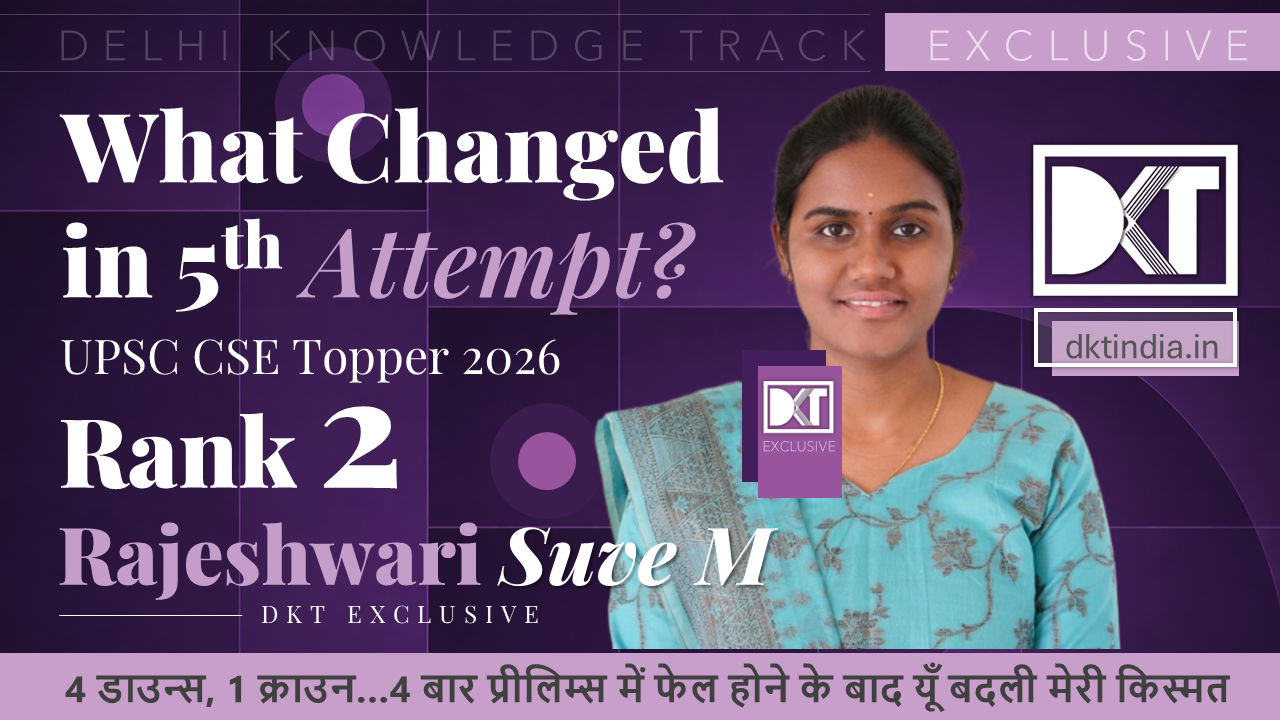
Rajeswari is unambiguous on one of UPSC's most debated questions: static always comes before current affairs. Her foundation rested on NCERTs for every core subject — Polity, Economy, Geography, History, and Environment. Only after building that base did she layer in standard reference books like Laxmikanth for Polity and GC Leong for Geography.
Her critical advice here is source discipline: pick two or three books per subject and go deep, rather than collecting ten sources and going shallow. Once the static base is solid, she recommends following just one current affairs magazine — revising it thoroughly rather than jumping between multiple publications. The Hindu served as her daily newspaper throughout preparation, and she added The Indian Express only during the Interview phase.
Rajeswari treats revision not as a step after preparation, but as the preparation itself. Reading a source once, she argues, is nearly useless without multiple rounds of revision. This principle governs her entire schedule.
For Prelims, she sets a firm cutoff: stop consuming new material one and a half to two months before the exam. The final stretch is reserved entirely for revising core concepts, keywords, and previously attempted test questions — not for exploring new topics. This discipline of "closing the tap" before the exam is one of her most actionable pieces of advice.
For Mains, she applies the same rule but with a shorter window — 15 to 20 days before the exam. In that period she revisits her own notes and the written answers from her test series, aiming for calm, confident recall rather than last-minute cramming.
Rajeswari's approach to Prelims test series is methodical and mathematical. She recommends joining a quality test series and attempting every test promptly. A standard series contains roughly 30 to 40 full-length tests, each with 100 questions — totalling over 4,000 questions practised across the preparation cycle.
But the real work happens after each test. She insists on sitting for three to four hours post-test to analyse every question: why each correct answer was right, why each wrong answer was wrong, and whether the mistake came from a conceptual gap or a logical error. Conceptual gaps demand going back to source material. Logical errors demand correction before the next test. This feedback loop, repeated across 4,000 questions, is what sharpens exam-day performance.
One of Rajeswari's most structured and shareable strategies is her three-round approach to the Prelims paper — designed specifically to manage time and negative marking.
In the first round, she attempts only the questions she is 100% confident about. No second-guessing, no time wasted. In the second round, she revisits the 50-50 questions — those where she can reason between two options. In the third round, she tackles questions where she can eliminate at least one or two options and make a logical guess. The key insight here is that logical guessing is a trained skill, not a gamble — and it is developed specifically through repeated test analysis.
Ethics is a paper that often intimidates aspirants, but Rajeswari approached it with a system. She solved Previous Year Questions daily — five to six answers per day — and received written feedback from her mentor throughout. She worked her way through every Ethics PYQ from 2011, the year the paper was introduced, focusing on decoding the keywords in each question before structuring the answer.
She also built a personal bank of 30 to 40 real-life examples drawn from IAS officers, entrepreneurs, women achievers, and historical personalities. These examples were not memorised randomly but mapped to specific themes so she could place them precisely in answers. She further used one or two well-chosen quotes — from Gandhi, Vajpayee, or Bose — per topic, deployed only when they genuinely strengthened the answer.
For General Studies and Essay, Rajeswari's answer writing philosophy is structured around one non-negotiable first step: understand exactly what the question is asking before writing a single word. Only after identifying the question's demand does she add facts, and even then, sparingly. Flooding an answer with facts without addressing the core demand, she warns, is one of the most common mistakes aspirants make.
For Essay, she wrote one to two full essays per week and sought mentor feedback after each one, incorporating corrections into the very next essay. Diagrams and flowcharts were used selectively in GS answers to break monotony and add visual clarity — but never as a substitute for substantive content.
Rajeswari's strategy, taken together, is a system built on depth over breadth, revision over consumption, and exam-day execution over endless preparation. Every element reinforces the same core belief: knowing the material is only half the battle — being able to deploy it calmly and strategically on the day of the exam is what separates toppers from the rest.